
 Last Updated:
How to Use a Compass - Lesson One
Basic Information
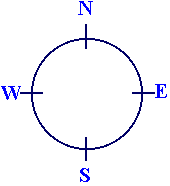
This is a very simple, very basic lesson. It is not sufficient for those who would like to travel safely in unfamiliar terrain.
The first thing you need to learn is something you most likely already know. That's the cardinal directions: North, South, East and West. Look at the figure and learn how they are related to each other. North is the most important. If you can find North, you can find anything.
Basic Compass
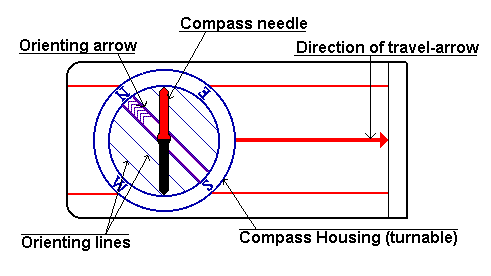
There are several types of compasses. The compass pictured here is a very typical compass that can be found in nearly any store that caters to outdoorsmen. Let's take a look at it. You see the red and black arrow? That's the compass needle. On some compasses it might be red and white. Regardless of the color, the red part of the needle always points towards the earth's magnetic north pole. That's the basis of what you need to know. It's as simple as that.
Now you know that the red arrow on a compass always points to the north. What if you don't want to go north? No problem. There's a rotatable ring on your compass. That's called the compass housing. On the edge of the compass housing, you will probably have a scale which generally runs from 0 to 360 degrees. Those degrees might also be called the bearing or the azimuth. The specific term you use depends on the context, but the terms are roughly equivalent.
Back to the question. What do you do if you want to go in a direction other than north? Perhaps you want to go in a direction halfway between North and West. That direction is obviously called Northwest .
Basic Navigation
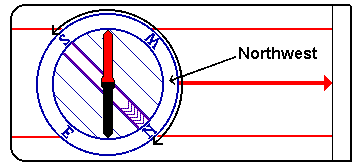
Let's use that as an example: You want to go northwest. The first thing to do is to locate northwest on the compass housing. Just as a reminder, that's exactly halfway between north and west. Then turn the compass housing so that northwest (315°) on the housing touches the large direction of travel arrow on the baseplate.
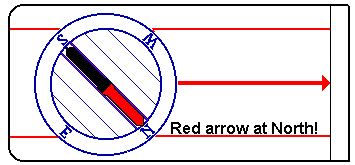
Hold the compass in your hand. You'll have to hold it quite level, so that the compass needle can turn. Then turn yourself, your hand, the entire compass, everything. Just make sure the compass housing doesn't turn, and turn until the compass needle is aligned with the orienting arrow and lines inside the compass housing.

You must be very careful with this step. It is extremely important that the red, north part of the compass needle points at north in the compass housing. If the red end of the needle points at south, you would walk off in the exact opposite direction of what you want! This is a very common mistake among beginners. Always take a second look to make sure you did it right!
There is one very simple thing you should look for to avoid going in the opposite direction: the Sun. In the early morning or late afternoon, it's easy to tell east from west. Of course, that depends on the time of year, too. In January, the sun rises and sets much further south than it does in July. What about noon? At noon, the sun is still a bit toward the south. If you are supposed to be heading north and have the sun in your face, it should ring a bell. You might be going the wrong way.
A second issue is the direction of travel arrow on your compass. Be sure you know which way the direction of travel arrow is pointing. On some compasses, like the one pictured on this website, the arrow points from the compass housing off the long end of the compass baseplate. On other compasses, the arrow points from the end of the baseplate and runs back through the compass housing. Don't get confused or you'll walk in the exact opposite direction you intend!
A third problem might be local magnetic attractions. If you are carrying something of iron or steel in your hand or your pack, it might affect the compass. Make sure there is nothing of the sort around. There is a possibility for magnetic attraction or disturbances in the soil as well, but this are rarely seen. It might occur if you're in a mining district known for mining iron ore.
When you are sure you've got everything set right, walk off in the direction the direction of travel arrow is pointing. While you are walking, you must keep the red end of the compass needle pointing toward north in the compass housing!
To avoid getting off course, be sure to look at the compass quite frequently. You needn't stare down at the compass, but you should pay attention. Once you have the direction figured out, aim yourself toward some point in the distance and hike to that spot. This gets more important when you use a map.
When do you need this basic technique? If you are out in the wilderness without a map, and you don't know exactly where you are, but you know that there is a road, trail, stream, river, or something long and big you can't miss provided you go in the right direction. Of course, you must know roughly where you are and in which direction you must travel to get to your desired destination. Then all you need do is follow the steps detailed above.
This method of direction finding is barely sufficient for real wilderness travel. It certainly isn't very accurate. You may be going in the right direction, and you probably won't go around in circles, but you'll be very lucky if you hit a small spot this way. What you need is a map.
Let's review the things you've learned...
- You know the directions and how they relate to each other.
- You understand the parts of the compass, including the compass needle, the direction of travel arrow, and the orienting arrow.
...and the steps you will use while hiking:
- Determine the direction you wish to go, locate that direction on the compass housing, and align that direction on the compass housing with the direction of travel arrow.
- Turn yourself and the compass until the red end of the compass needle points toward north on the compass housing and is aligned with the orienting arrow.
- Follow the direction of travel arrow on the compass, keeping the compass needle pointing north and aligned with the orienting arrow on the compass housing.
If you are taking a long hike in unfamiliar terrain, you should always carry a good map that covers the terrain. This is especially true if you plan on leaving the trail. It is in the interaction between the map and a compass that the compass becomes truly valuable. Go on to the next lesson to learn more.